 EN
EN


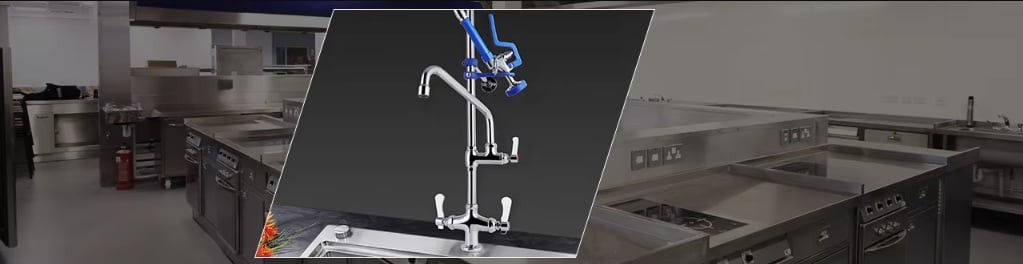
The advantages of a pre rinse kitchen faucet with a flexible hose.
Jun.16.2026
Beyond Fixed Reach: Why Flexibility Changes the Workflow
A fixed faucet has a fixed radius. Everything beyond that radius requires awkward maneuvering—tilting pots, repositioning sheet pans, or carrying heavy cookware to the sprayer. A pre rinse kitchen faucet with a flexible hose eliminates that constraint entirely. The hose extends, bends, and reaches into every corner of a deep commercial sink, allowing the user to bring the water to the work rather than the work to the water.
That shift might sound minor, but in a high-volume kitchen, it adds up fast. A dish station that processes 300 to 400 plates per service can save seconds per item simply by not repositioning each piece. Over a shift, those seconds become minutes. Over a week, those minutes become hours of labor that can be redirected to prep or cleaning.
Ergonomic Gains That Reduce Fatigue
The physical toll of repetitive reaching and twisting is well documented in foodservice injury reports. The flexible hose design of a pre rinse kitchen faucet reduces the need for extended shoulder and wrist movement. Instead of leaning forward or stretching to reach the far side of a sink, the operator pulls the spray head to the item. That small change in posture reduces strain across multiple shifts.
A mid-sized catering operation in the Pacific Northwest tracked employee complaints related to wrist and shoulder discomfort before and after switching to flexible-hose pre-rinse units. Over a six-month period, reported discomfort dropped by roughly 40 percent among dish station staff. The equipment change wasn't the only factor, but the staff consistently cited the reduced reaching as the most noticeable improvement. That's the kind of data that doesn't show up on a spec sheet but matters enormously in a labor-intensive environment.
Coverage That Matches the Sink
Commercial sinks come in various sizes, and a spray head with limited mobility simply cannot cover a large three-compartment sink effectively. A flexible hose, typically ranging from 36 to 44 inches in length, provides the reach needed to clean oversized items like stockpots, sheet pans, and roasting trays.
The practical advantage is straightforward: items stay in the sink. There's no need to lift a heavy pot out of the sink to spray it from an angle. The hose brings the spray directly to the surface, which also minimizes splashing and water waste. For operations that handle large-volume cookware, this coverage translates directly into faster turnaround between loads.
Water Efficiency Through Better Targeting
A common misconception is that more water equals better cleaning. In reality, precision matters more than volume. A flexible hose allows the operator to direct the spray exactly where it's needed—on stubborn food residue, around the rim of a pot, or into the corners of a baking sheet. That targeted application means less water is wasted on areas that are already clean.
The U.S. Environmental Protection Agency's WaterSense program sets a maximum flow rate of 1.28 gallons per minute for commercial pre-rinse spray valves. Many older fixed-head units operate well above that threshold, sometimes reaching 2.5 to 4 gallons per minute. A flexible-hose pre-rinse faucet, when paired with a low-flow spray valve, combines precise targeting with responsible water use. Replacing just one conventional pre-rinse valve with a WaterSense-labeled model can save a typical foodservice facility more than 7,000 gallons of water annually.
Durability That Handles Daily Abuse
Commercial kitchens are not gentle environments. Hoses get pulled, twisted, and bumped against sink edges hundreds of times per day. A flexible hose built with stainless steel braiding and reinforced connections withstands that abuse far better than a standard rubber hose. The braided construction resists kinking, corrosion, and the wear that comes from constant flexing.
The connection points matter as much as the hose itself. Brass fittings and swivel joints allow the hose to rotate freely without putting stress on the threads or seals. That design detail extends the service life of the entire assembly and reduces the frequency of replacements—a cost consideration that facility managers often overlook when comparing upfront prices.
Limitations Worth Acknowledging
A flexible hose is not a cure-all. The extended reach can tempt operators to use the sprayer as a general-purpose cleaning tool beyond the sink area, which introduces sanitation and splash concerns. The hose also requires periodic inspection for wear at the connection points, where repeated flexing can eventually cause fatigue.
Additionally, the flexibility that makes the hose useful also means it requires a certain amount of care during storage. Leaving the hose stretched across the sink or dangling over the edge increases the risk of accidental damage. Simple practices—docking the spray head properly and avoiding sharp bends—go a long way toward maximizing service life.
That said, for the vast majority of commercial and heavy-use residential kitchen applications, the advantages of a pre rinse kitchen faucet with a flexible hose outweigh the considerations. The combination of ergonomic benefit, coverage, water efficiency, and durability makes it a practical upgrade over fixed-spout alternatives.
Brand & Production Introduction
Jiangmen Youchu Sanitary Ware Co., Ltd. manufactures pre-rinse faucets with 304 stainless steel construction and reinforced spring mechanisms, backed by an 8,200-square-meter production facility and an annual output exceeding 376,000 units. The combination of material quality and production scale ensures consistent performance across high-volume orders for commercial kitchens, restaurants, and institutional foodservice operations.