 EN
EN


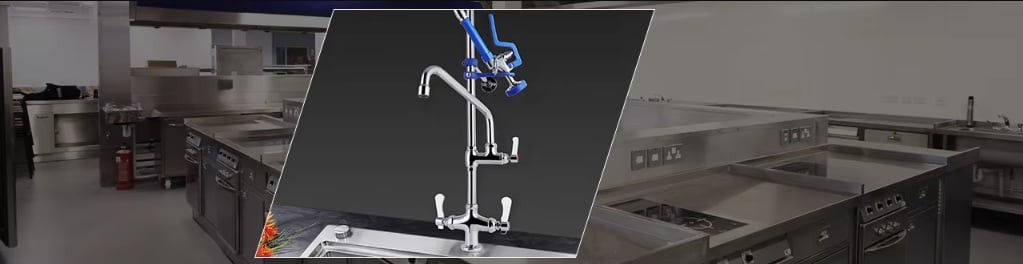
Proper technique for rinsing dishes with a pre-rinse kitchen faucet.
Understanding What a Pre-Rinse Faucet Is Actually Designed to Do
A pre-rinse kitchen faucet is not a standard sink fixture with a fancy spray head. It is a purpose-built pressure delivery tool, engineered to remove food soils from dishes, pots, and trays before they enter a dishwasher. The spray valve produces a concentrated, high-velocity stream that cuts through residues that ordinary tap flow would spread around rather than remove.
Most commercial pre-rinse units operate at 1.6 GPM (6 L/min) or lower under the current NSF standards, down from older units that ran at 1.8 GPM or higher. The key insight here: flow rate alone does not determine cleaning effectiveness. Spray pattern, valve pressure, distance from the surface, and the user's technique all contribute more than raw water volume. Getting these variables right means faster results and less water used per rack.
Positioning the Spray Head and Controlling Distance
The most common mistake when using a pre-rinse faucet is holding the spray head too far from the dish surface. At distances beyond 15 centimeters, the spray cone widens and loses impact velocity. The water that lands on the dish does not have enough force to dislodge stuck food, so the operator ends up spraying longer to compensate.
A working distance of 7 to 12 centimeters from the spray valve to the dish surface is where most units deliver peak mechanical cleaning action. At this range, the stream remains focused and carries enough kinetic energy to shear food soils off the surface without requiring excessive water volume.
Angle matters too. Hitting a flat dish surface at a perpendicular 90-degree angle tends to push debris outward toward the edges rather than off the surface entirely. Coming in at a 20-to-30-degree tilt directs the spray force along the surface plane, which carries residues toward the drain more efficiently.
Using Consistent Directional Strokes Rather Than Random Spraying
Random circular or back-and-forth spraying is less efficient than deliberate directional passes. A systematic approach clears dishes faster and reduces the total spray time per item.
The method that works best in most high-volume dish stations:
1.Hold the dish at a slight downward angle over the sink basin, so gravity assists the flow direction.
2.Start the spray stroke at the far edge of the dish and work toward the near edge in one smooth motion.
3.For plates, use two or three overlapping longitudinal passes rather than a circular sweep.
4.For pots and pans, spray the interior first with a clockwise circular motion, then rinse the exterior.
| Dish Type | Recommended Technique | Typical Spray Time per Item |
|---|---|---|
| Dinner plate | 2–3 longitudinal passes, 10 cm distance | 3–5 seconds |
| Soup bowl | Single spiral inward from rim | 4–6 seconds |
| Hotel pan (full size) | Grid pattern, overlapping strokes | 8–12 seconds |
| Stockpot (interior) | Circular spray with rotation | 10–15 seconds |
| Cutting board | Long diagonal sweeps | 4–7 seconds |
These time ranges assume a standard 1.6 GPM spray valve with adequate inlet pressure (typically 30–60 PSI at the valve). Pressure below that threshold reduces impact velocity significantly.
Managing Food Solids Before Spraying
A pre-rinse faucet handles food soils efficiently, but it is not a garbage disposal. Spraying heavy solid debris directly toward the drain strainer will clog the strainer faster and put more suspended solids into the drain line. A brief pre-scrape, either by hand or with a rubber bench scraper, removes the bulk of solid food before rinsing begins.
A food-service consulting group that tracked plate return times at a mid-sized hotel in Foshan, China, found that dishwashing stations where workers consistently pre-scraped dishes before pre-rinsing processed 22% more racks per hour than stations where pre-scraping was inconsistent. The bottleneck was not dishwasher cycle time but spray station throughput.
The pre-scrape does not need to be thorough. Removing the major food chunks and leaving thin film residues is enough. The pre-rinse faucet handles those residues efficiently; trying to wipe plates completely clean before rinsing is wasted motion.
Adjusting Technique for Difficult Residues
Certain foods require modified technique. Starchy residues (rice, mashed potatoes, oatmeal) harden as they cool and become resistant to standard spray passes. For these, a short 10-to-15-second pre-soak in the spray basin, using a low-angle spray to flood the surface before the directional cleaning pass, softens the residue enough for the main spray pass to clear it.
Greasy residues behave differently. The spray head produces cold or lukewarm water in most pre-rinse stations; cold water does not emulsify fats. For greasy pots or pans, using a brief spray of the hottest available water (at the temperature the supply line delivers) first, then following with directional passes, moves grease off the surface far more effectively than extended cold spraying.
Some operators find it useful to keep a small brush near the pre-rinse station specifically for baked-on or caramelized residues. A few manual passes with a stiff-bristle brush, combined with the spray, cuts handling time significantly for problem items.
Avoiding Common Habits That Reduce Efficiency and Cause Splashback
Splashback is one of the biggest hygiene concerns at dish-rinse stations. Water and food particles landing outside the sink basin contaminate work surfaces and require extra cleanup time. A few habits create most of the problem:
- Spraying at flat horizontal dish surfaces from directly above: the force deflects outward in all directions.
- Spraying at the interior walls of tall pots from a steep downward angle: water ricochets off the far wall.
- Holding the spring arm fully extended and rigid: a relaxed grip that allows natural spring movement helps control spray direction.
- Operating the valve trigger at full pressure for light residues: partial trigger depression reduces flow and splash for lightly soiled items.
Keeping items inside or just above the sink basin during spraying, and angling them so deflected water falls back into the basin, solves most splashback issues without requiring any changes to equipment.
How Faucet Quality Affects Long-Term Technique Consistency
Technique only stays consistent when the equipment behaves predictably. A spray valve with inconsistent trigger resistance, a hose that kinks under normal movement, or a spring arm that fails to return smoothly all interrupt operator focus and lead to compensatory habits that reduce efficiency.
The mechanical characteristics of the pre-rinse faucet, including valve stroke, spring arm tension, and hose flexibility, determine how natural the correct technique feels. Units built with 304 stainless steel tubing and solid brass valve internals maintain consistent pressure delivery and smooth operation across heavy daily use. Over time, equipment quality directly shapes how well best practices translate into actual kitchen performance. Youchu's line of commercial pre-rinse faucets is designed with those operational realities in mind, offering the structural durability that supports consistent technique at high-volume dish stations.