 EN
EN


What is a pre rinse sprayer and how does it differ from a standard sprayer?
Jun.26.2026
Basic Definition and Core Function
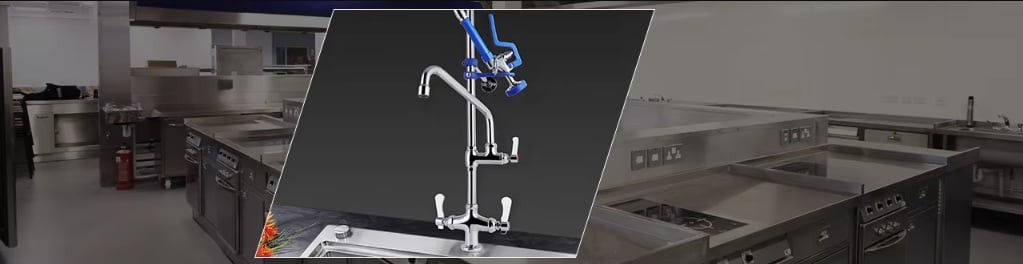
A pre rinse sprayer is a handheld spray nozzle attached to a flexible hose, typically mounted above or beside a commercial kitchen sink. It delivers a concentrated, high-pressure stream of water designed specifically for removing food residue from dishes, pots, and pans before they enter the dishwasher. The sprayer is operated by a squeeze lever that controls water flow, and many models include a clip that locks the lever in the open position for continuous use.
The name tells the story: pre-rinse. The sprayer handles the rough work—blasting away stuck-on food, grease, and debris—so the dishwasher can focus on sanitation rather than scraping. That division of labor is the core of its purpose.
What a Standard Sprayer Actually Is
A standard kitchen sprayer—the kind found on most residential faucets or as a side spray on commercial decks—is a different animal. It typically delivers a broader, lower-pressure spray pattern intended for general rinsing, sink cleaning, and occasional dish wetting. The flow rate is often higher, but the spray force is lower because the design prioritizes coverage over impact.
Standard sprayers are not built for the duty cycle of a commercial kitchen. They are used intermittently, for short bursts, and they are not expected to remove baked-on cheese or dried egg from a sheet pan. Their hoses are shorter, their triggers are less robust, and their spray patterns are optimized for versatility rather than raw cleaning power.
Pressure and Flow: The Technical Divide
The most significant difference between a pre rinse sprayer and a standard sprayer lies in the relationship between pressure and flow. Pre-rinse sprayers concentrate water into a narrow, high-velocity stream that delivers significant impact force at the point of contact. Standard sprayers disperse water over a wider area, reducing the force per square inch.
A pre-rinse sprayer features a typical flow rate of 1.28 – 1.6 gpm for low-flow models, a narrow, concentrated and high-impact spray pattern, and is designed for continuous, high-frequency commercial use with a 36–44 inch hose length. In comparison, standard sprayers have a higher flow rate of 2.0 – 4.0 gpm with broad, dispersed, lower-impact spray, suitable for intermittent short-burst daily use, and are equipped with only 12–24 inch short hoses.
The feature contrast highlights a counterintuitive reality: a pre-rinse sprayer often uses less water per minute than a standard sprayer, yet delivers more cleaning force. That efficiency comes from nozzle design and pressure optimization rather than raw volume.
Construction and Durability Differences
Commercial pre-rinse sprayers are built to survive years of daily abuse. The bodies are typically constructed from chrome-plated brass or stainless steel, with internal components designed for repeated impact and temperature cycling. The hoses are braided stainless steel, resistant to kinking and corrosion.
Standard sprayers, by contrast, are often plastic-bodied with rubber hoses. They are adequate for light residential use but fail quickly under the demands of a commercial dish station. The trigger mechanism is a common failure point—standard sprayer triggers are not designed for the thousands of actuations per day that a pre-rinse sprayer handles routinely.
A restaurant equipment supplier in Texas documented replacement rates across 50 commercial kitchens over a two-year period. Pre-rinse sprayers from reputable manufacturers averaged one replacement every 4.2 years. Standard sprayers used in the same role—on commercial sinks where they were pressed into pre-rinse duty—averaged one replacement every 7 months. The data speaks for itself: using the wrong tool for the job is expensive.
The Sanitation Factor
Pre-rinse sprayers play a specific role in the sanitation workflow. They remove gross soil—the visible food debris—so the dishwasher can apply heat and chemicals to sanitize the surface. That separation of tasks is not arbitrary; it reflects the way commercial dish machines are designed. Most high-temperature dishwashers are optimized for sanitizing clean dishes, not for removing stuck-on food.
Standard sprayers lack the spray force to effectively remove gross soil, which means more food residue enters the dishwasher. That residue can clog filters, reduce wash efficiency, and increase the frequency of machine maintenance. The sanitation risk is indirect but real: a dishwasher that works harder to remove food is less effective at sanitizing.
When a Standard Sprayer Might Suffice
Not every application requires a commercial pre-rinse sprayer. For residential kitchens, light-use catering setups, or bar sinks where the primary task is rinsing glasses and utensils, a standard sprayer is entirely adequate. The lower spray force is not a disadvantage when the residue is minimal.
The pre-rinse sprayer becomes necessary when the volume and type of food residue exceed what a standard sprayer can handle. Kitchens that process large quantities of baked-on or fried foods, commercial bakeries with sheet pans covered in caramelized sugar, and institutional cafeterias with high-volume tray lines all benefit from the concentrated cleaning force of a pre-rinse sprayer.
The choice comes down to matching the tool to the task. A pre-rinse sprayer in a residential kitchen is overkill; a standard sprayer in a high-volume commercial kitchen is a bottleneck. Knowing the difference saves money on the front end and prevents frustration on the back end.
Product Manufacturing Introduction
Jiangmen Youchu Sanitary Ware Co., Ltd. manufactures pre-rinse sprayers with 304 stainless steel construction, reinforced springs, and anti-clog nozzles. With certifications including NSF and CE, and a production capacity exceeding 376,000 units annually, the company supplies commercial kitchens, restaurants, and institutional foodservice operations with sprayers designed for the specific demands of high-volume pre-rinse work.