 EN
EN



Why are commercial spray faucets often specified with a minimum pipe size to maintain pressure?
Have you been in a busy kitchen to see how a spray faucet works? The user pulls down the nozzle and pushes the lever and the spray faucet sends a stream of water and easily removes food waste. That looks very effortless. But behind that simple act are some very smart designs. One very important aspect that is often overlooked is the water supply line dimensions. It is very common to see a commercial spray faucet that requires a specific pipe size. The specific pipe size is not an arbitrary design. It is a design that is based on the principles of physics. It is a design that will greatly determine how the spray faucet functions.
You can think of the flow of traffic on a highway as analogous to the flow of water through a pipe. Just as larger pipes mean more water can flow unrestricted, wider highways mean more cars can flow through. Smaller pipes mean water flow is bottlenecked, just as fewer lanes on a highway mean a bottlenecked flow of traffic. In a commercial kitchen, the spray faucet is designed to take care of that potential bottleneck by ensuring that a strong and steady flow of water is delivered. Manufacturers like Youchu prioritize the use of high grade materials and strong construction, thus the spray faucet is designed to achieve the best results possible, but it is up to the installer to achieve that. So let's delve into the science and logic behind the specs.
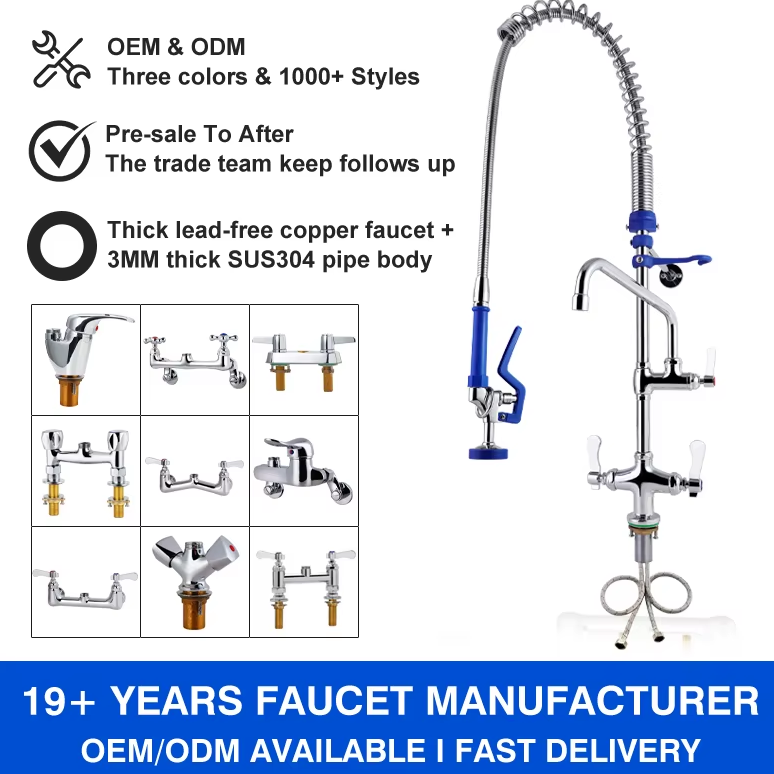
The Physics of Flow: Why Pipe Size Matters to Pressure
To understand the pipe size requirement, we need to talk about flow rate and water pressure. Flow rate means the volume of water at a given time (usually at a minute level) that is moving through a pipe. Water pressure is the force that is pushing that water, similar to a spring and its tensions. As water flows through pipes, it loses pressure. It is a result of the friction that occurs as the water comes into contact and moves against the walls of the pipe. This phenomenon is called pressure drop.
In general, smaller diameter pipes create more friction, leading to larger pressure drops for the same flow rate. If you try to push flow rates that are too high for the diameter of the pipe, you will experience significant drops in pressure. When the water reaches the commercial spray faucet, it may not even have the energy to create the effective spray. It may work, but the stream will be weak. Therefore, specifying a minimum pipe size will ensure that the pipe can provide the proper flow rate for the required pressure drop so that the faucet has enough pressure.
High Flow Rates are Essential for Commercial Faucets
A home faucet can have a flow rate of 1.5 to 2.2 gallons per minute. But for commercial spray faucets, the flow rate required is at least 2.5 gallons per minute to effectively rinse pots, pans, and dishes. The flow rate is what determines the cleaning efficacy.
As we have just learned, pushing a higher flow rate through a pipe causes a greater pressure loss in that pipe. A pipe that might be perfectly okay for a low flow home faucet becomes a serious choke for a high flow commercial unit. The water simply cannot get through fast enough without dropping flow. This is why the supply pipe for a commercial spray faucet has to be large. The supply pipe is designed to accommodate the flow rate of water the faucet is designed to discharge.
Complementing the Faucet's Design with the Right Pipe
Consider the design that goes into a quality faucet. A manufacturer like Youchu uses thick 304 stainless steel and solid copper for their faucets. They design the internal flow channels and the spray tip for a particular flow and pressure. The strong spray that you count on is a product of their design effort.
By connecting undersized piping, you are not just reducing flow, you are changing the entire system's performance. The faucet may not spray at the right pressure to trigger the spray, and the spray may be uneven or just not sufficient. You are essentially throttling a performance machine of its fuel supply. It may still run, but it'll never be able to perform at its full potential. Operating within the specified minimum pipe size set by the manufacturer is just abiding by the engineering used in the product.
Real World Impacts in a Busy Kitchen
Think about a busy restaurant's kitchen during the dinner rush. The dishwasher constantly uses the spray faucet to pre rinse the dishes. If that faucet is connected to undersized piping, multiple problems can occur. The first is that the spray will be weak, so it will take longer to rinse each dish. This will slow the entire dishwashing process, creating a bottleneck. The second is that if any other water outlets in the kitchen are being used at the same time, such as filling a pot at a sink, the pressure to the spray faucet will drop, causing it to spray even weaker. Work will come to a standstill, as a weak spray means a slow rinse.
Time and money are lost due to this inefficiency. However, if a commercial spray faucet is properly installed, it will maintain a strong spray, even if its demands are great. This is essential for the continuous workflow in professional kitchens.
Hygiene and Safety Issues
In any commercial kitchen, the importance of cleaning and sanitizing is critical, and safety issues abound. A cleaning faucet that sprays weakly, even if the faucet is working, is not able to remove food soil from dishes and equipment. This is a potential source of hygiene issues. In contrast, a safety and sanitation faucet that is installed properly will provide a strong, constant spray that will assist in thorough pre rinsing and enhance overall sanitation.
In addition, commercial kitchen cleaning is often done with hot water, and if a cleaning faucet has a small faucet, the high flow rate and small diameter of the tube can create a phenomenon described as cavitation, which can actually result in a reduction in temperature of the water at the outlet. In order to maintain cleaning and sanitizing, it is critical to maintain both the flow rate and temperature.
Manufacturer's Expertise and Your Role
When manufacturers set a minimum pipe size for commercial spray faucets, they are not being difficult for the sake of being difficult. They are providing critical insights from their engineering and testing expertise. They understand the constraints necessary for their product to function. Companies like Youchu, with almost 20 years of experience with a factory, know the importance of providing reliable inserts, and they even depend on the customer to provide the proper installation for optimal performance.
As a buyer or installer, you are obligated to comply with the requirements. If you put in the proper pipe, the faucet will work to its full potential without creating any problems in the future. From time to time, you will have to spend more money and time to put in a proper pipe. However, the satisfaction that will come from the proper work and performance of the powerful, high-quality commercial spray faucet will justify the expense and work, and it will provide strong, reliable performance for a very long time.
Ultimately, the Minimum Pipe Size Specification shows how attention to detail makes a difference. It shows that the faucet isn’t an island. It’s part of a system. For that system to function optimally, all components, from the water main to the spray nozzle, must work in unison. By following this specification fully, you demonstrate that your commercial kitchen needs to have the appropriate cleaning capacity, and that it will have this ability at the time it is needed.