 EN
EN


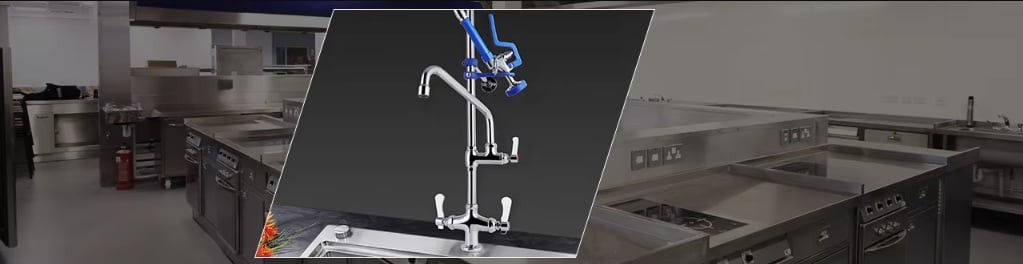
The importance of standardized fittings for commercial kitchen faucets.
Every part of an appliance in a commercial kitchen gets utilized day in and day out. That's why we put a lot of stress on the functionality and durability of the commercial kitchen faucets we install. However, functionality and durability aren't the only things that should matter. Standardized fittings also play an equally, if not more, important role. These fittings connect your entire plumbing system. They are the parts that control the flow of water. Standardized fittings are the only plumbing fittings that will guarantee your system that flow consistency and efficiency, along with the safety. They are the silent protectors that govern water safety, streamline your operation, and save you money. This article will analyze why the rest of the food service industry relies on standardized fittings and why you should too.
Ensuring Safety and Compliance
Using standardized fittings to keep your water supply safe and to comply with the laws of the land is one of the most important benefits of standardized fittings. Standardized fittings are built and verified to meet important safety benchmarks. These standards, such as ASME A112.18.1/CSA B125.1, span several plumbing supply fittings, also used in commercial kitchens. Meeting their requirements helps to confirm the fittings are made of safe, non-contaminating configurations that protect the water supply from potential contamination. For example, certificates may ensure that no leachable lead and other contaminants exist.
Also, plumbing codes often specify certain kinds of fittings and connections for commercial use. As an example, rules may dictate that pre-rinse sinks and dishwashers fittings be connected to grease interceptors in a certain way to avoid clogs and possible environmental harm. Employing standard fittings that are guaranteed to meet these codes assists your kitchen in passing health inspections and help avoid fines or lawsuits. This is a vital step in developing a kitchen that is not only functional, but also legally compliant.
Assuring Durability and Longevity
Commercial kitchen fittings face a relentless schedule of continuous use, and exposure to diverse water, chemicals, and physical impact. Standardized fittings are made to tackle these. They are often made of hefty materials, such as solid brass or stainless steel, that resist corrosion and maintain structural strength over countless cycles. The production of these fittings includes thorough testing for strength and durability to ensure they meet the daily needs of a busy kitchen.
This dedication to durability sustains value over the long haul. A valve or faucet that is equipped with high-end standard fittings is less prone to leakage, cracking, or excessive damage. This also reduces downtime and expenses arising from emergency repairs and productivity loss. Standardized plumbing fittings from the start is investing in a plumbing system that can be depended upon to work every day and offer a superior ROI over the system’s lifetime.
Operational Efficiency Improvement
In a commercial kitchen, efficiency is all about the manner in which time and resources are utilized. Standardized fittings in the kitchen improve operational efficiency as they are designed to work optimally. For instance, faucets that feature standard aerators can maintain a good water pressure for rinsing, while reducing water flow. This thoughtful faucet design helps to save water, and in turn, lowers utility costs.
In addition, standardized fittings guarantee compatibility and use ease. When every component in a system uses the same specs, they are guaranteed to work together. Kitchen personnel do not have to deal with working their way around adapters nor do they have to make impromptu alterations to join a faucet to a sprayer. This compatibility increases the speed of the first install and every additional reconfiguration of the kitchen layout becomes easier. Installing in a kitchen becomes more efficient, and so does the kitchen team’s ability to do their work because seamless interfaces are installed. This ultimately increases efficiency across their tasks.
Simplifying Maintenance and Supply Chain
The lack of standardized fittings in the plumbing system can be a maintenance nightmare. When every faucet or connection uses a different, specialized piece, the chaos of plumbing can become extremely costly because every time there is a breakdown, there are numerous specialized fittings that need to be sourced to ensure the faucet works. Luckily, with standardized fittings, there is universal code that plumbing components can be standardized to. When a kitchen employs standardized fittings in their plumbing, the used fixtures have a universal connection that enables maintenance personnel to use a single, common part that is easy to find to address numerous fixtures in the kitchen.
Using common fittings makes it easier to manage inventory. Businesses can stock common replacement parts, like seals or cartridges, knowing they will fit multiple fixtures. This minimizes the space and money used on spare parts. Maintenance technicians can complete repairs and reduce equipment downtime without searching for obscure parts. Standard fittings help maintenance remove and replace worn parts on equipment like aerators, which makes maintenance quick and keeps the kitchen active.
Supporting Hygiene and Sanitation
The kitchen must be clean, which makes incorporating features that support sanitation necessary for the design of standardized fittings. Standardized fittings must have smooth, non-porous surfaces that have no gaps for bacteria, grease, or food particles to get into. This design requirement makes it easier to clean and effectively reduce the risk of cross-contamination.
Also, there is an expectation for these parts to protect the water supply. Because these parts are used to transport drinking water, they are also expected to meet some additional standards to ensure the water doesn’t get contaminated by the leaching of materials or coatings. To a certain extent, a kitchen operator using certified and standardized fittings can be more certain the water being used for cooking, cleaning, and dishwashing is unadulterated and safe, which is a fundamental aspect of food safety.
Enabling Cost Effectiveness
Though the costs of standardized fittings are likely to be more expensive than non-standard fittings, the real benefit comes with long-term savings within the climate of the building. Effectively, the savings from varied water usage, lesser maintenance costs, and lesser emergency repairs, and the longer lifespan of the equipment all combine for a lesser overall ownership expense. A fitting that leaks could waste hundreds of gallons of water in a year. That expense is no longer there with a dependable, standardized part.
Most importantly, the investment protection from standardized fittings, the sidestepping of penalties for non-compliance, and the guaranteed passage of health inspections are all real financial benefits built into the standardized fittings. The predictability and risk avoidance from investment in standardized fittings are worth the money because it saves money from having to deal with the unexpected costs due to component failure, code violations, forced early replacements, and so on. If your business runs on very narrow margins, the financial predictability, and resource efficiency, will be very important for the business to remain profitable.
When it comes to the faucets in your commercial kitchen, the fittings are just about the most standardized and so, the most impactual. For a commercial kitchen, streamlined, efficient and safe operations are paramount and with standardized fittings, there’s code compliance, durability, ease of maintenance, and support for stringent hygienic workflows and so, streamlined, efficient and safe operations become a reality. The fittings are a small detail that makes a very big difference.