 EN
EN


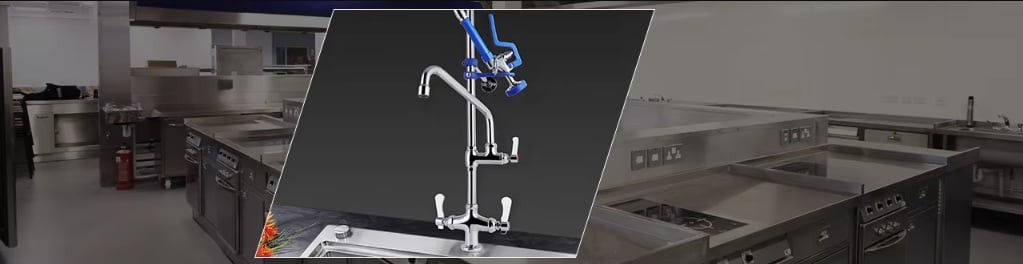
Installation tips for a commercial faucet in a commercial kitchen sink.
Putting in a commercial faucet shouldn't take all day. That said, it's still an important fixture that will be used every day. Good installation will make sure that there will be no problems with the faucet, and that it'll make cleaning and services easy for years to come. This is true whether you're fitting out a new kitchen for a restaurant, or simply replacing and old, worn out faucet. Doing things correctly the first time will prevent a lot of hassle in the future, and save headaches and money. This guide will take you through the key installation steps, from the time you take the commercial faucet out of the box to experiencing the full power of it's spray for the first time.
Ready, Set, Go: Plan Ahead for an Effortless Installation
If you start the work right away, you will have a bad time. Take some time to plan out the work that needs to be done. First, you need to assess your work area. Are you changing out the old faucet or setting up a new sink for the first time? If you are changing out the faucet, make sure to check the mounting holes and the water supply lines. Are they going to work with your new wall-mounted faucet? You will need to measure the distance between the hot and cold water inlets and make sure the wall is sturdy enough to hold the faucet, especially when the pre-rinse is in use.
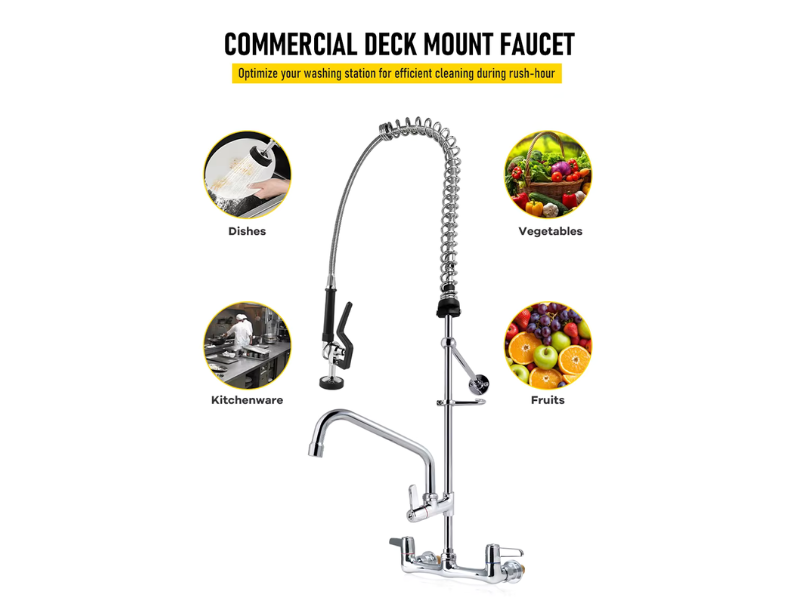
Before doing anything else, make sure all items in the box are accounted for. Parts should include: spray wand, faucet handle, flexible hoses, a solid mounting bracket, supply hoses, riser hose, washers, and screws. Then check the list of needed parts in the instruction manual. Pay attention to the list of washers; if there are some missing, that's better to know now than halfway through underneath the sink. Also make sure to gather a screw driver, adjustable wrench, plumbing tape, and that's if level if you have one. If applicable, the main supply valves for the sink should be located and turned off. This will help to avoid a dramatic face-full of cold water.
After the prep work is done, it's time for the hard work: it's time for the hands-on work of mounting. If you are doing a wall-mount faucet, you will need to select a position. Use a level to ensure it is perfectly straight and line up the screw holes to properly attach the wall bracket to the studs. This is very important as this bracket has to hold the entire mounting system and needs to be strongly and properly secured.
People can usually attach the faucet body to the bracket from the front when the bracket is up. After that, connect the water supply lines from the back or the bottom. Use seal tape in a clockwise direction on the faucet threads to seal them. Hand tighten the nuts before using a wrench to tighten them. Do not overtighten as this can strip the threads or cause the fittings to crack. There will be instructions to connect the pre-rinse sprayer hose to the diverter valve. These connections will be simple on a well-designed faucet. Before finishing, check that all the connections are tight, especially the faucet body, to ensure it is stable in its mount.
Finishing Strong: Testing and Future-Proofing
All set and ready to finish this up. Carefully turn the water supply back on. Before you turn the handles, look for any leaks or weeping from where you connected the water. Small leaks are far easier to deal with than large ones. Once you look and see it is dry, you can turn the handles on, both hot and cold, to flush out any debris from the line.
Test every function on the faucet. Activate the pre-rinse sprayer and see if it switches over from the main spout. For the main spout, test both the high-pressure jet and the wide-spray, then see if the hose retracts and docks easily. If the faucet has handles, turn them and feel whether or not they control the temperature and flow with ease. If you start to hear any odd banging or feel any vibrations, signifying that there's an air hammer, then the water pressure is likely too high for the faucet and you might need to install a pressure-reducing valve for it. More than anything else, the thoroughness of this check ensures that the faucet can handle the rigors of the kitchen from day 1.
A Partner Rather a Product
No installation goes without a flaw and that's why there are a variety of options that customers can choose from. The performance of a business for a sustain a good period of time relies on the design and materials used. selecting a faucet that has a well-organized inner design structure and a thick copper core. The copper exterior is good since it won't retain and house bacteria but is also good for food safety. Heavy gauge stainless steel is a good fitting on the exterior as they do well in the constant exposure of water, heat, and the cleaning chemicals that can be used also they can stay for a period without corrosion.
Consider also the particular characteristics that complement the workflow of your kitchen. Control over hot and cold water that is separated is good on a dual handle design, that is good during tasks like washing of greens that are delicate and on the pans there is grease. Multi-functioned pre rinse sprayer that that flexible, long reaches are very important on the cleaning of deep sinks and large pots. Ultimately, the time has come for the vendor you choose to be the one who has confidence in the product. Products that come with installation assistance, remote access to replacement components like cartridges or spray heads. You can be sure that your installation was not a waste of effort for a commercial faucet.