 EN
EN



What makes a commercial kitchen faucet different from a standard one?
Anyone who has spent time in a bustling restaurant kitchen knows it operates on a different level. It's a high-pressure, high-temperature, and high-demand environment where every piece of equipment, from the ovens to the faucets, is pushed to its limit daily. The faucets built for this world bear little resemblance to the charming one in a home kitchen. They are engineered to withstand immense stress, passing rigorous tests for performance, endurance, and sanitation. Selecting the correct commercial kitchen faucet is a critical decision that directly impacts the safety, efficiency, and smooth operation of any foodservice business.
Manufacturers who specialize in this field operate under a clear philosophy: design for the worst-case scenario. In a restaurant, use is intense and often unpredictable. This fundamental difference in demand creates a dramatic divide between how commercial and residential faucets are conceived, designed, and built.
The Core Distinction: Engineered for Endurance, Not Just Convenience
Consider how an average household uses a kitchen faucet: filling a pot, washing dishes, rinsing vegetables. It might be cycled on and off a few dozen times a day. Now, imagine a faucet in a busy restaurant kitchen. It is activated hundreds, if not thousands, of times daily. This staggering difference in usage dictates every aspect of design, from the internal materials to the external construction.
A failure in a commercial setting is not a minor annoyance; it is a full-scale operational emergency. It can halt service, lead to health code violations, and result in significant financial loss. Therefore, reliability and resilience are not optional features but the foundational requirements of any professional-grade commercial kitchen faucet. This relentless focus on endurance is what truly separates professional equipment from consumer products.
Structural Integrity and Rugged Materials
The most immediate difference lies in the substance and build quality. While residential faucets may utilize thin-walled brass or even plastic components, commercial units are built like industrial hardware.
Heavy-Duty Construction
Commercial faucets feature bodies made from solid cast brass or premium-grade stainless steel. These materials are chosen for their superior strength and resistance to impact. In a hectic kitchen, equipment gets bumped, leaned on, and struck by heavy pots. The construction must prevent dents, cracks, or deformation that could compromise functionality and lead to leaks.
Industrial-Grade Valve Systems
This is the heart of the difference. Residential faucets often use simple rubber-washered cartridges or basic ceramic discs, which would wear out rapidly under constant commercial use. Commercial faucets employ heavy-duty valve systems, frequently utilizing advanced ceramics or high-performance polymers. These are engineered to withstand extreme water pressure, resist mineral buildup from hard water, and deliver smooth, reliable operation for millions of cycles. Leading manufacturers invest in patented valve technology developed through extensive research to ensure longevity and consistent performance.
Performance and Efficiency Under Pressure
Beyond mere durability, a commercial faucet must perform flawlessly under the most demanding conditions.
High-Flow Rate and Instant Response
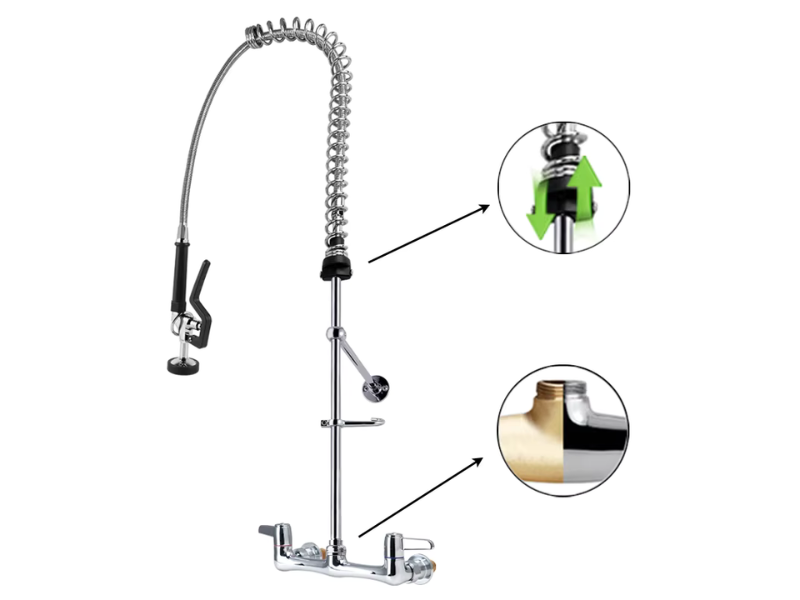
In a commercial kitchen, time is money. Staff cannot wait to fill a large stockpot. Commercial faucets are designed for high-flow rates, delivering a powerful, consistent stream the moment the handle is engaged. The pre-rinse faucet, a staple in commercial kitchens, exemplifies this with a versatile pull-down spray head that instantly switches from a high-velocity jet for cleaning to a gentle aerated stream for filling tasks.
Temperature Stability and Critical Safety
In a home, fluctuating water temperature is an inconvenience. In a commercial kitchen, where water can be near-boiling for sanitization, it is a serious safety hazard. Commercial faucets incorporate advanced pressure-balancing or thermostatic mixing valves. These mechanisms instantly compensate for pressure changes elsewhere in the plumbing system (like when another fixture is used), preventing sudden, dangerous spikes in water temperature and protecting staff from scalds.
Hygiene, Cleanability, and Code Compliance
Restaurant kitchens are governed by strict health codes, and faucets are a focal point for sanitation protocols.
Seamless, Sanitary Design
Residential faucets often have decorative details, seams, and crevices that can trap food debris, grease, and bacteria. Commercial faucets prioritize a clean, minimalist design. A high-arching gooseneck spout allows easy filling of oversized pots and provides clear access for cleaning underneath. Joints are minimized, and surfaces are smooth and seamless, enabling quick, thorough wiping to meet health inspection standards.
Durable, Corrosion-Resistant Finishes
While home faucets offer a variety of decorative finishes, commercial finishes are about durability and chemical resistance. A heavy, industrial-grade electroplated chrome finish is standard. It provides exceptional resistance to corrosion, harsh cleaning chemicals, abrasion, and fingerprints, ensuring the faucet maintains a clean, professional appearance for years despite constant exposure to steam and caustic cleaners.
Specialized Functionality for Professional Tasks
Commercial faucets are purpose-built tools designed for specific, repetitive tasks uncommon in residential settings.
The Essential Pre-Rinse Function
The wall-mounted pre-rinse faucet is a prime example. Its sole function is to efficiently blast food debris from plates and pans before dishwashing. It features an ergonomic, pistol-grip spray handle with a trigger control for instant on/off operation, a heavy-duty retractable hose rated for thousands of cycles, and a secure docking mechanism. This specialized tool drastically improves kitchen workflow and dishroom efficiency.
Enhanced Ergonomics and User-Focused Design
Every detail is considered for the user. Handles are larger and designed to be operated easily with a wet, soapy hand or even an elbow. Spout height and reach are optimized for large, deep commercial sinks and bulky cookware. To further promote efficiency and hygiene, hands-free options like foot-pedal or sensor-activated faucets are popular, reducing water waste and minimizing cross-contamination.
Choosing the Right Partner for Your Commercial Needs
Given the critical role of this equipment, selecting a manufacturer is as important as selecting the model. This choice will impact daily operations for years to come.
The Value of Proven Expertise and R&D
A manufacturer with nearly two decades of focused experience in commercial and smart water systems brings invaluable real-world knowledge. They understand the challenges of diverse kitchen layouts, varying water pressures, and local regulatory codes. This expertise results in products that are not only durable but intelligently designed to solve specific problems, such as integrating water-saving features without sacrificing performance or developing complementary systems like point-of-use water filtration.
Adherence to Global Standards and Certifications
A reputable commercial manufacturer designs products to meet or exceed stringent international standards for performance, material safety (like NSF/ANSI 61 and lead-free compliance), and water efficiency. Their products are tested for hundreds of thousands of cycles, not just hundreds. This global perspective ensures reliable performance whether the faucet is installed in a North American hotel, a European bistro, or an Australian resort.
The Importance of a Comprehensive Solution
The best suppliers offer more than a product; they provide a complete solution. This includes expert guidance on model selection for specific applications, reliable after-sales support, and access to a coherent range of complementary products. For kitchen designers and facility managers, this holistic approach ensures all components work seamlessly together to create a safe, efficient, and compliant kitchen environment.
Conclusion
In summary, the difference between a commercial kitchen faucet and a standard one is the difference between a precision-engineered professional tool and a consumer appliance. It is built from the ground up for a life of extreme use, with superior materials, industrial-grade internal mechanics, specialized functionalities, and designs that prioritize hygiene, safety, and efficiency. Opting for a genuine commercial kitchen faucet from an experienced and dedicated manufacturer is a foundational investment for any foodservice business. It is an investment that pays daily dividends in reliability, compliance, and operational support, silently underpinning the work of the team that creates exceptional dining experiences.